
Tag: #commissioning

  • We Need to Talk about Commissioning

    We Need to Talk about Commissioning

    It had to happen, we can’t put it off any longer. We need to talk about what commissioning is. Or is not.

    It could be presented in a plain, factual manner … there are stages to commissioning, these are arranged in a cyclical process.

    Here’s the obligatory diagram describing the key stages of commissioning – its from the NHS, they love a process:
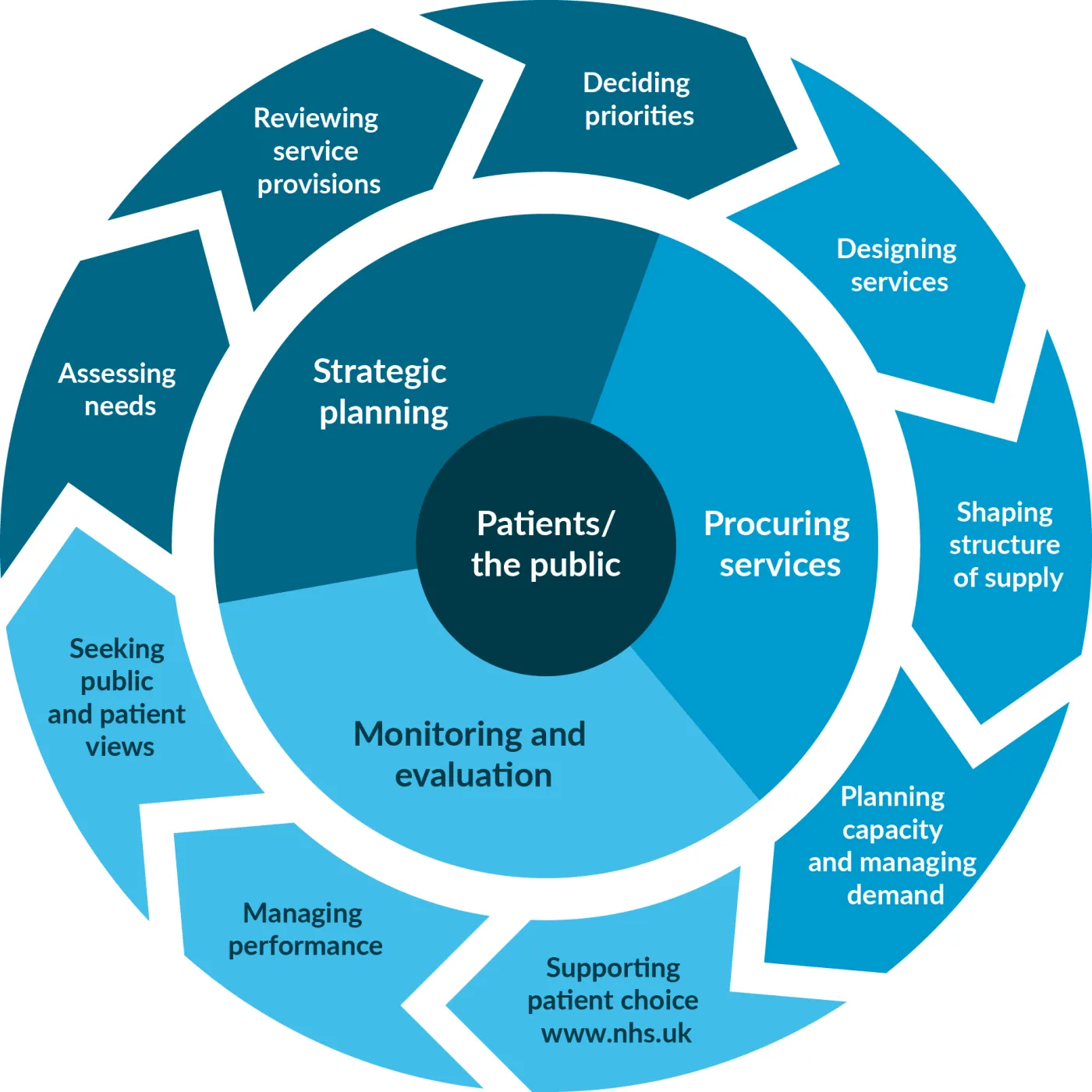
    A picture of a circular commissioning cycle describing the various stages from needs assessment, planning, designing, procurement through to delivery and evaluation.
    The NHS Commissioning Cycle, Kings Fund

    Most explanations start you with ‘Assessing needs’, proceeding through to designing and planning.There’s a tricky bit after, referred to as ‘shaping the market’ or ‘market making’ (like a crafts workshop). This is essentially the point where it becomes clear that no-one is providing the service you need – more likely there are plenty of providers, but none of them do quite the job. So a commissioner has to consider how they ’shape’ provision to meet their beautifully designed service specification. Skipping through that bit means we arrive at ‘Procurement’. This might feel like firmer ground – there are often teams of people skilled in procurement, contracts, the law. With larger procurements, a commissioner might find themselves handing it all over to procurement teams – and in some instances it can feel as if its disappeared into a different world and language. Eventually (usually very eventually) a contract emerges with a provider attached. There can even be a brief period of elation, or perhaps its relief, as the new service provider sets up, announces its existence. This may occasionally be marred by the need to quietly, if possible, manage the old provider, or those providers who didn’t get the contract and who think they could still do a better job. It’s all very energy consuming.

    Then, as a colleague once said to me, ‘now it’s simple, they do their job, we performance manage them’. Until the contract approaches its end date. Or, more usually, the service being provided doesn’t meet the needs of those using it – or those who need it but don’t use it. This is also a tricky bit – who is to blame? The provider for being inefficient in the face of people with individual needs? The commissioner for not getting the service specification right? Or the funding for not meeting the actual costs? Or – and yes, this does get used – the people who use the service for not understanding how to use it?

    The issue I have with the ‘commissioning cycle’ is that it is often applied as if it’s an instruction manual – follow these steps and proceed to the end. In my various roles as a public sector ‘commissioner’, there has usually been some form of assurance or performance framework applied to these acts of commissioning by a regulatory body. These frameworks usually worked from this commissioning cycle, setting standards for each stage and requiring us jobbing ‘commissioners’ to present evidence that we are meeting these standards at each stage. Before this becomes too much like whingeing (as if), it is understandable, this approach to assurance – how do you learn what works if you don’t look for evidence? (My research and academic colleagues will be rushing to engage that debate …). The problem with the approach is it assumes commissioning is procedural, that it is largely about understanding the stage you are in and then doing the things that stage requires. Hidden within this, perhaps, is also an assumption that, well, almost anyone can do it. Give a reasonably well adapted manager (have you met any?) the commissioning manual and they’ll get through it ok. Like a recipe – the cake will come out like a cake, just take a bite and make suggestions like ‘next time perhaps use more of everything’.

    In some respects this is all true – but only if you use the commissioning cycle as a guide. There is, in my experience, a different reality of commissioning, one that has – to my knowledge, not yet been put into a neat diagram. In their report ‘Towards collaboration: VCSE and health and care commissioning relationships’ (2023), the Universities of Birmingham, Plymouth and London seem to approach something fundamental when they describe a Commodified approach to commissioning, comparing it to a Collaborative approach. 
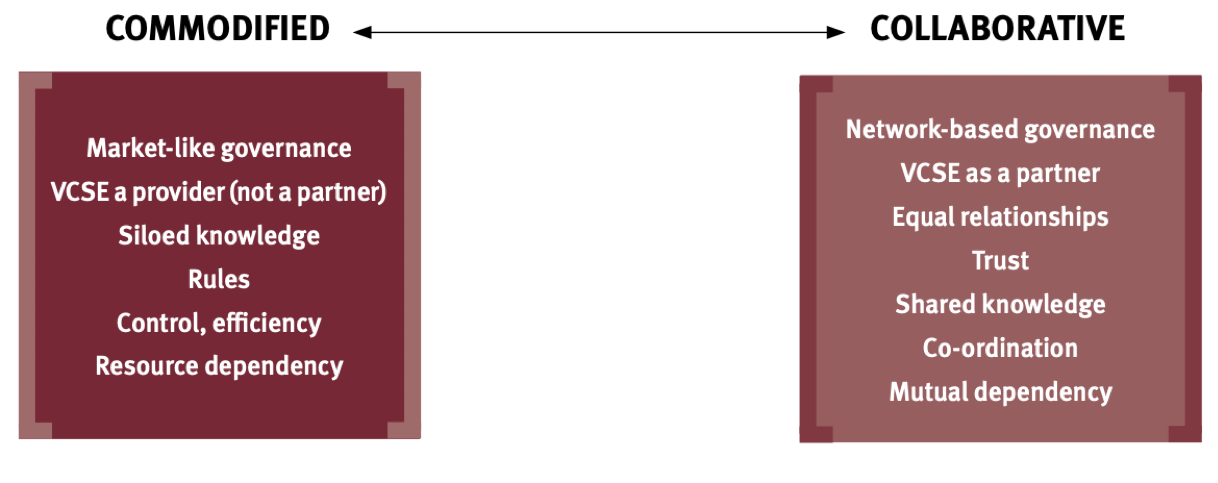
    A graphic that describes the difference between Commodified Commissioning (eg VCSE are treated as providers only) and Collaborative Commissioning (eg VCSE are partners throughout all stages of commissioning)
    Commodified vs Collaborative Commissioning, ‘Towards collaboration: VCSE and health and care commissioning relationships’ 2023, BAYES Business School, University of Birmingham, University of Plymouth

    In Commodified commissioning, the stages of the commissioning cycle can be seen, glowing out beneath the surface – procedural, rules, silo-ed knowledge (and power). Yet in their description of Collaborative Commissioning, there are features that ring true with my actual experience of commissioning – shared knowledge, coordination, trust. It feels like this is pointing to some far more fundamental description of commissioning, something that stands behind all the various diagrams of commissioning cycles – as if the diagrams are the glyph we all focus on, not realising the actual goddess is there in the shadows beyond.

    I once said – thinking at the time it was a facetious remark – that commissioning was not a science but an art – meaning that, in my experience, it rarely proceeded through defined stages. Instead, not unlike the best buddhism, all aspects of commissioning existed all at once, at the same time – with commissioners just a part of its reality. 

    A less ethereal way of seeing it is that, to commission is to understand that any aspect of the traditional commissioning stages may need to co-exist for a while and, further, there several other aspects to commissioning that might also require acknowledgement. We operate in a human world (and an increasingly stroppy environmental one) and humans, not known for their individual predictability (well, except perhaps on social media), bring all that ‘stuff’ with them – self, ego, compassion, drive, enthusiasm, pessimism, privilege, culture … and on its goes.

    Instead of seeing ‘commissioning’ as a process or a cycle, it may be better to see it as a set of skills, even a vocation. And instead of seeing it as something that a small team of people – the ‘commissioners’ – ‘do’ in the world, it could be seen as a more collaborative and collegiate way of working to improve the world. Sure, that sounds idealistic, but, in my experience, real improvements rarely resulted from following the commissioning manual – they usually came from building a shared understanding – not just of what was needed but also of what could help – and of the challenge that nothing ‘off the shelf’ ever met these needs.


  • The stories we tell: what does the VCSE talk about when it talks about commissioning?

    The stories we tell: what does the VCSE talk about when it talks about commissioning?

    ‘Yeah, I know … they say they want to get better, want to treat us as equals but they don’t seem to change much. Too obsessed with their own stuff’ she pauses, watches the remnants of the earlier shower drip from the moss overflowing the gutter while the words come, ‘I doubt they intend it but they do come across as if they know best all the time. Kind of arrogant. You have to be quite resilient to take that on because it’s not a one-time thing, you have to deal with it every time you talk, in every interaction.’ There might be the suggestion of a sigh but it’s masked by the raising of her tea mug.

    We’re talking about a relationship, it has the feel of a familiar conversation. There’s no sense of angst, more acceptance, of the way it is, of this being a continual work. The relationship in question – before anyone panics about imminent indiscretion – is the one between the members of a mixed group of statutory health & care managers and their (single) representative from the voluntary & charity sector.

    It’s a story that I’ve heard before, this one about equality in a relationship. It won’t take long to spot it in most, if not all, written agreements between the statutory and the voluntary, community or social enterprise sectors (VCSE) . Here’s one from one of the early innovators in integration:

    ‘To realise the benefits of collaboration with these VCSE organisations, they need to be recognised as essential partners and providers within the commissioning process, as opposed to welcome optional extras.’

    Greater Manchester Voluntary, Community and Social Enterprise (VCSE) Commissioning Framework and Delivery Plan, Jan 2020

    That was written in 2020 – the story will have been told many times over preceding years – and there’s truth in it.

    There are seven basic plots, if you follow Christopher Booker’s propositions. It may feel like there are more, but Booker brings them all down to some variation of these core seven:

    The Seven Basic Plots

    Overcoming the MonsterRags to Riches
    The QuestVoyage and Return
    ComedyTragedy
    Rebirth

    The stories we tell when we get together in the VCSE sector (in its broadest, most dazzlingly complicated sense) may even be echoes of these seven plots. The setting and details may change but there are a collection of well-told tales including:

    Becoming an equal: by far the most commonly told story I’ve heard, like a friend who wishes their partner of many years would pay them more attention, but is too nervous to address it (Overcoming the Monster? The Quest? Rebirth?)

    Ending short termism: from one off grants to short contracts, they all mean providers are chasing the next source of income even as they set up the latest offering – Tragedy? Comedy? Overcoming the Monster?

    Getting core costs funded: almost ad nauseam we wish funders would recognise and fund the core costs that always sit at the heart of any charity – The Quest? Rags to Riches?

    Finding an alternative to competition: we dislike (on the whole) that any commissioning process seems to result in providers bidding against each other (The Quest?)

    Acknowledging inflation as real – like ghosts, real inflationary uplifts embedded as routine in contracts can be hard to spot – sometimes you may never see them, but there’s always someone else who once did, probably on a cold, dark night (The Quest?)

    Sometimes I’m not sure about these stories. They get told almost instinctively when we gather together. There is truth at their core – there are always truths within every story (even ones about hobbits). Like a good story that gets retold, though, they have become part of our culture, a source of reassurance – or a way of reassuring others … ‘I’m like you, I’m part of this’.

    How do you tell a different story about equal partnership – and is ‘equal’ just the grail – the quest – not as fulfilling, if found, as the promise of it? Perhaps we should ditch the term ‘equal’ and recognise ‘difference’. We may need to more precisely define those moments where equality is the goal – a decision about priorities, funding, or the design of a service. There may be times we need acknowledge difference – size and scale of organisations can affect their ability to take part, take risks, innovate. Similarly, our sources of knowledge about what is needed may look very different – community-generated stories of experience set alongside population level data, for example. Both important and useful – we could worry less about whether one trumps the other and get better at listening and understanding the story they are telling.

    It may all sound terribly woolly, liberal-minded – like any good relationship, it’s complicated. That is the nature of what we’ve set out to grapple. The old stories will continue to tell their truths. In building a collaboration between statutory and VCSE partners, one that aims to decide, design and commission services together, we may need to ignore these stories for a time – set them aside and create the next set of stories.

    Or should that be CO-create …

  • Mythical beasts: commissioning with the charity sector

    Mythical beasts: commissioning with the charity sector

    ‘Well, good luck’

    The parting words of … is it advice? … from a colleague after they listened patiently to me explain how a small group of people working in the voluntary, social enterprise and community sector want to change public sector commissioning.

    I doubt luck has much to do with it. Though it would be a comforting thought – that successful change, in the end, comes down to luck. We’d all have to try less, sit back and wait for that lucky moment. People who have a reputation for being lucky would be in great demand. The whole culture of management in the charitable and public sector would be radically different – meetings would disappear, less email – perhaps a regular get together in a cafe, pub, park (pick your delight) to see if anything lucky has happened yet.

    Anyway, luck probably has little to do with it. Perhaps.

    Sitting in the echoing room, the small stage at the front holds a piano. It doesn’t look very grand, even though it has the classic curves, yet it has enough presence to distract and so the stage curtains are partially drawn, leaving it to lurk in the shadows.

    The conversation at the table is about ‘commissioning’. There are five of us, all from various charities or social enterprises. The agenda for this morning’s meeting of the VCSE Alliance acts as a coaster for various coffee cups. We’ve reached the bit where we talk in smaller groups. The small hall echoes with conversation, the scrape of a fidgeting chair on the scuffed parquet floor. 

    ‘Honestly, we need to abandon the lead provider model. We’ve recently come out of a collaborative where we were the lead provider. All it means is the buck stops with you when the shit hits the fan.’ The person speaking jabs her finger on the table in front of her to emphasise the word ‘shit’. The rest of us nod. ‘The commissioners want you to resolve everything. The other providers in the collaborative all disappear. Suddenly. Not their problem.’ She looks across the hall. I resist the temptation to work out who she is looking for. 

    ‘It’s all they want. The commissioners. Lead provider, I mean’ says the man on my left. There’s a pause, a suggestion that other opinions are floating around that comment. Then the woman on far end of the table, who has just finished a biscuit, says ‘We were lead provider for a bid. It was fine. It just worked. We knew the other providers quite well. There was a trust already between us.’

    When we talk about ‘commissioning’ we’re talking about a mythical beast, appearing in different guises relative to the person, the place and the context. Our experience of it changes and the stories we tell are as varied as, well, as we are. I will explore the nature of commissioning in later posts, though it can be a dry thing – expect talk about a cycle.

    Different people within the VCSE have different experiences of commissioning. That there is dissatisfaction within the sector about the nature of their relationship with funders or ‘commissioners’ is a consistent truth. When this VCSE Alliance talked about its priorities, changing the way commissioning happens appeared in the short-list, quite high – just below finding better ways to demonstrate the sector’s collective impact on people’s lives. That feels right – and its a relief that we didn’t go for the usual ‘dealing with the funding crisis’ as a priority – because, despite the truth of it, that would be predictable and lose focus on those things we can actually control. Showing what we do and building better relationships with funders and the people who have the same agenda, that feels like a more developed way of managing the eternal challenge of funding.

    As the clatter of a beige lunch arrives (there’s a gluten-free option for someone, it looks more appetising, I keep a watchful eye on it …), the Alliance agrees to form a working group. There is a pause after I ask for volunteers. The quiet whirring of individual minds, evaluating how much it matters, how much time it might involve. Then a couple of hands go up, gently, unsure and by the end of the meeting there are four people from the VCSE who want to work on this together. This is how the most difficult yet important work begins, a few people willing to give their time and effort.

    We haven’t met yet, the emails are exchanging about dates and times. It will be at least a month before we meet.  The aim of our work is to get into the nature of these dissatisfactions over commissioning – what exactly is it we want to change? That’s the key question … beneath most dissatisfaction is a call to change. When we first meet, we’ll be doing well if we agree the basic scope of what we want to do. But it’s a start. And I’ll post regularly here about the work. Its good work, it feels important in a way that I would struggle measure (sorry commissioners).